
November 4, 2026
The Charleston in American Mahjong: How Every Pass Works
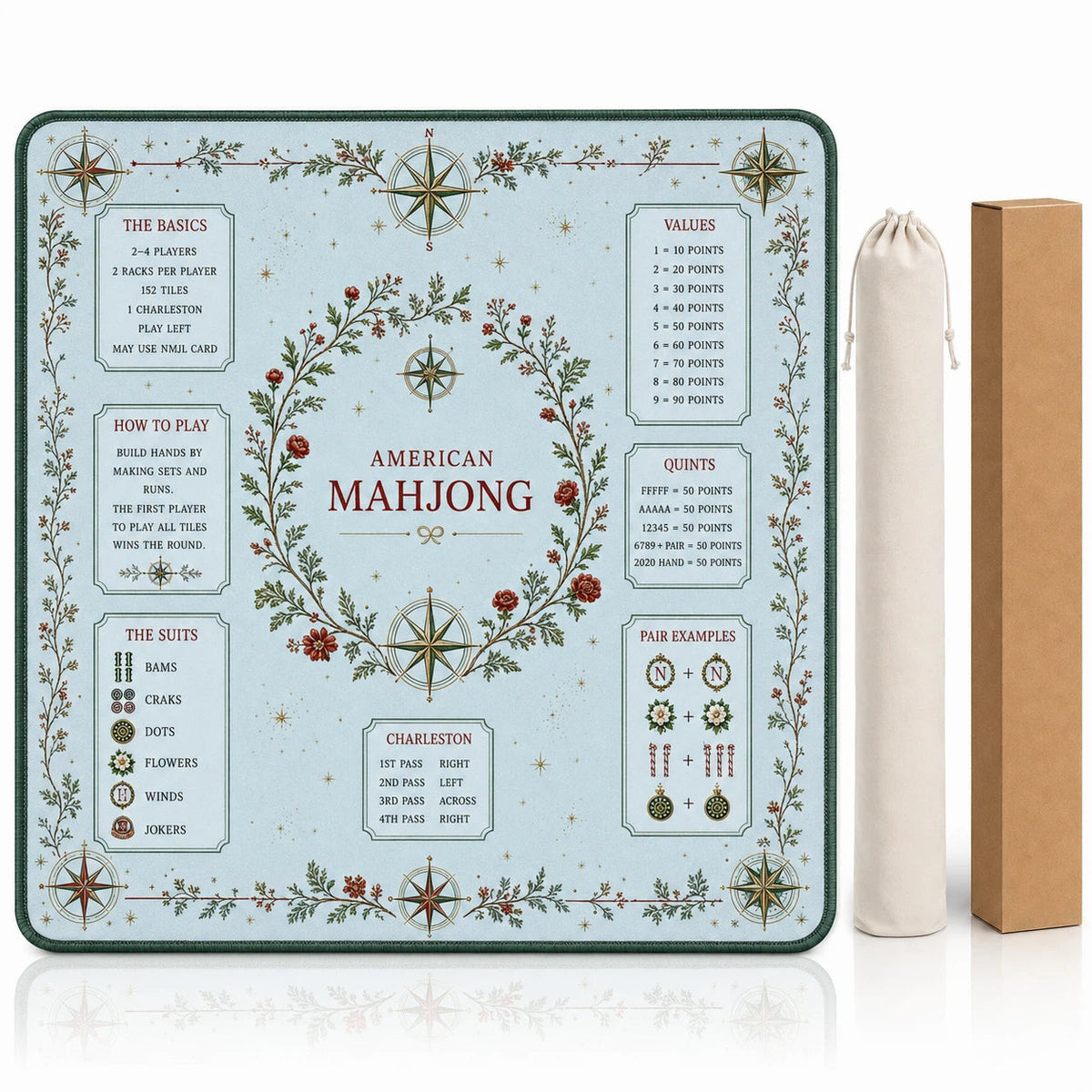
If you are learning American mahjong, the Charleston is usually the first part that feels unfamiliar. Before anyone discards a tile, every player trades unwanted tiles with the others in a fixed series of passes. This guide walks through each pass in order, explains the optional parts, and covers the rules people most often get wrong.
If you are brand new to the game, start with our beginner's guide to playing American mahjong, then come back here.
What the Charleston is for
In American mahjong, every winning hand has to match a hand printed on the current card from the National Mah Jongg League (NMJL). The deal gives you a random set of tiles, and it rarely points cleanly toward one hand on the card.
The Charleston helps with that. It is a structured exchange that happens after the deal and before East makes the first discard. You give away tiles that don't fit what you hope to build and receive tiles from the other players. It is one of the features that sets American mahjong apart from most other styles of the game.
When the Charleston begins, East holds 14 tiles and everyone else holds 13 (our guide to setting up American mahjong covers the deal). Everyone gives and receives the same number of tiles on each pass, so those counts stay the same. Tiles are passed face down.
The first Charleston: right, across, left
The first Charleston is required. Every player takes part in all three passes, and each pass is three tiles.
- First right. Pass three tiles to the player on your right.
- First across. Pass three tiles to the player sitting opposite you.
- First left. Pass three tiles to the player on your left. This is the last pass of the first Charleston, and a blind pass is allowed here.
An easy way to remember the order is R, A, L: right, across, left.
The second Charleston: left, across, right
Once the first Charleston is finished, the table moves on to a second Charleston unless someone stops it. It runs in the reverse order:
- Second left. Pass three tiles to your left.
- Second across. Pass three tiles across.
- Last right. Pass three tiles to your right. Blind passing is allowed on this pass.
Any one player can stop the second Charleston, and they don't have to give a reason. If one player stops it, it is stopped for everyone. The time to speak up is after the first left and before the second left. Once anyone has picked up the tiles from the second left pass, it is too late, and the second Charleston is played through to the end.
Players usually stop it when their hand is already coming together. Stopping it every game tends to frustrate the table, so save it for hands that need it.
The courtesy pass
After the Charleston comes one last, optional exchange called the courtesy pass. It happens only between players sitting opposite each other.
- Each pair of opposite players may exchange zero, one, two or three tiles.
- Both players say how many tiles they want to pass. If they disagree, the lower number wins. If you want to pass three and the player across wants to pass one, you each pass one.
- Each pair decides on its own. East and West can trade even if North and South choose not to.
Under the NMJL standard, stopping the second Charleston does not cancel the courtesy pass. Some home groups play it differently, so check with your table.
Blind passing
A blind pass lets you avoid breaking up tiles you want to keep. It is allowed on only two passes: the first left (the last pass of the first Charleston) and the last right (the last pass of the second Charleston).
On those passes you still send three tiles, but they don't all have to come from your hand. You can put out zero, one, two or three of your own tiles and make up the difference with tiles being passed to you on that same pass, sending them on without looking at them. On the first left, that means passing along some or all of the tiles coming from the player on your right. On the last right, it works the same way in the other direction.
The key word is blind: you may not peek at the incoming tiles before you pass them on. Blind passing is not allowed on the other four passes or in the courtesy pass.
Jokers can never be passed
Jokers may not be passed at any point in the Charleston, including the courtesy pass, and it is also against the rules to receive one. If a joker is passed to you by mistake, hand it back right away so the player can choose another tile. For more, see our guide to joker rules in American mahjong.
Every pass at a glance
| Pass | Direction | Tiles | Required? | Blind pass? |
|---|---|---|---|---|
| First right | Right | 3 | Yes | No |
| First across | Across | 3 | Yes | No |
| First left | Left | 3 | Yes | Yes |
| Second left | Left | 3 | No, any player can stop it | No |
| Second across | Across | 3 | No | No |
| Last right | Right | 3 | No | Yes |
| Courtesy pass | Across | 0 to 3 (lower number wins) | No | No |
If the passes are new to your group, a mat with the passing order printed on it saves a lot of "which way now?" moments. You can find some in our mahjong mats with rules collection.
How to choose what to pass
There is no single right answer, but a few general habits help.
- Study the card before the first pass. Sort your tiles, then find two or three hands your tiles lean toward. Keeping a few options open early is usually safer than committing to one hand right away. Our guide on how to read the mahjong card explains the layout.
- Value natural pairs. Jokers can't be used in a pair, so a pair is harder to replace than a tile that could end up in a larger group.
- Pass tiles that fit none of your options. Lone tiles that don't belong to any hand you are considering are the easiest to let go.
- Notice what comes in. The tiles other players pass you show what they are not collecting, which can help later when you decide what is safe to discard.
- Use the blind pass when you are stuck. If you have nothing you want to give up on the first left or last right, pass incoming tiles along instead.
Common Charleston mistakes
- Forgetting that the second Charleston reverses. The first runs right, across, left. The second runs left, across, right.
- Passing a joker. It is never allowed, on any pass.
- Peeking during a blind pass, or blind passing on any pass other than the first left and last right.
- Passing fewer than three tiles. Every pass except the courtesy pass is three tiles. On a blind pass, the incoming tiles fill out the three.
- Trying to stop the second Charleston too late. Once the second left tiles have been picked up, it continues.
- Treating the courtesy pass as required. It is optional, and the player who wants to pass fewer tiles sets the number.
Frequently asked questions
Is the Charleston required in American mahjong?
The first Charleston is required for every player. The second Charleston happens unless any player stops it, and the courtesy pass is always optional.
Can you pass a joker in the Charleston?
No. Jokers can never be passed or received during the Charleston or the courtesy pass.
What is a blind pass in mahjong?
On the first left and the last right, you may pass along some or all of the tiles coming to you on that same pass without looking at them, instead of giving up tiles from your own hand.
How many tiles are exchanged in the courtesy pass?
Zero to three, only between players sitting across from each other. If the two players want different numbers, they exchange the lower number.
The Charleston takes a few games to feel natural, and after that it becomes second nature. Keep the order in front of you while you learn, and talk through any house rules before the first tile is passed.