
November 4, 2026
Joker Rules in American Mahjong: When You Can Use and Swap Jokers
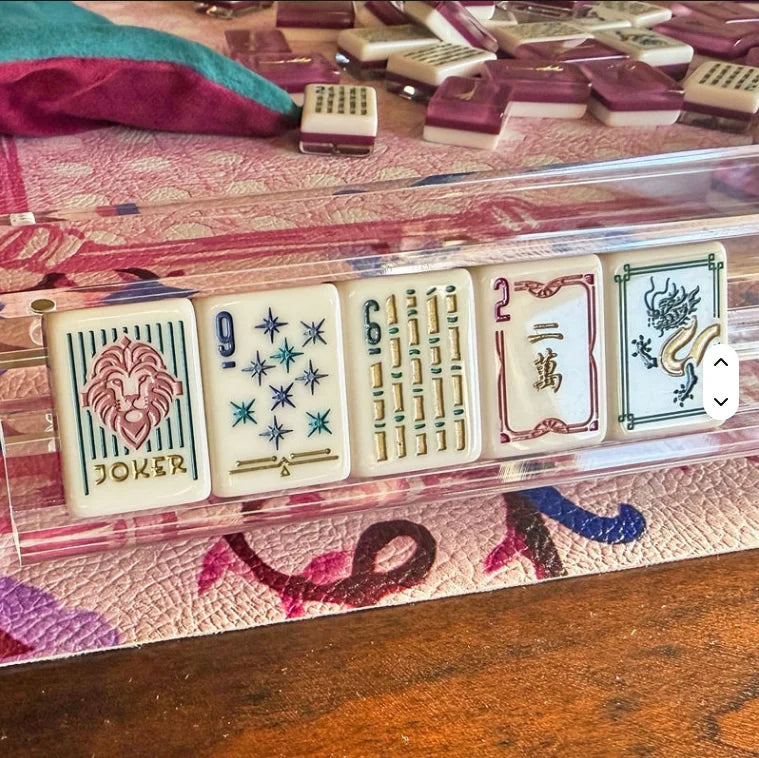
Jokers are the most flexible tiles in American mahjong, and a common source of table questions. This guide covers where you can and can't use a joker, how to take one from an exposure, what happens to a discarded joker, and how the jokerless bonus works. The rules follow the National Mah Jongg League (NMJL) standard. House rules vary, so agree on them before you play.
If you are just getting started, our beginner's guide to American mahjong covers the whole game first.
How many jokers are in American mahjong?
A standard American mahjong set has eight jokers. Most other mahjong sets don't include jokers at all, so make sure any set you buy is an American set, like the ones in our American mahjong sets collection. For a breakdown of the other tiles, see how many tiles are in an American mahjong set.
Where you can use a joker
A joker can stand in for any tile, but only inside a group of three or more identical tiles:
- Pung: three identical tiles
- Kong: four identical tiles
- Quint: five identical tiles
- Sextet: six identical tiles
That includes groups of winds, dragons and flowers, not just numbered tiles. A group can contain any number of jokers, and in your concealed hand a group can even be all jokers. An exposed group always includes at least one natural tile, because you only expose a group by calling a discard, and a joker can never be called.
Where you can never use a joker
- In a pair. A pair must be two natural tiles. Under NMJL rules there are no exceptions.
- As a single tile. Some hands on the card include single tiles, and a joker can't fill any of them.
- In groupings of different tiles. A set of one of each wind, or a year spelled out in tiles, is made of singles, so jokers can't be used there either.
- In Singles and Pairs hands. Those hands are built only from singles and pairs, so they are always played without jokers.
A hand that uses a joker in a pair or as a single is not a valid mahjong.
How to exchange a joker
When an exposed group on any rack contains a joker, you can take that joker by giving the natural tile it stands in for. Players call this exchanging, swapping or redeeming a joker. The rules:
- Only on your turn. You can never exchange during another player's turn.
- After you take your tile. First pick from the wall, or call a discard and place your exposure. Then you can exchange.
- With the exact matching tile. If a player has exposed a kong of North winds made of three Norths and a joker, you need a North to take that joker.
- From any exposure. You can take a joker from any player's exposure, including your own.
- As many as you can. If you hold several matching tiles, you can make several exchanges in one turn, even from different racks.
- Before you discard. Once you discard, your turn is over.
You don't need exposures of your own to exchange. When the joker is on someone else's rack, say what you are doing and offer the tile.
Exchanging after you call a discard
Calling a discard makes it your turn, so you can exchange jokers once you have placed your new exposure. Two limits apply. First, you can't call a discard just to swap it for a joker. A called tile has to go into a new exposure or complete your mahjong. Second, you can't take a joker and add it to the exposure you just made. A joker you take goes into your hand.
What you can't do
- You can't reverse an exchange by giving a joker to take a natural tile from an exposure.
- You can't take a joker from anyone's concealed tiles, only from exposed groups.
- If a player's hand has been declared dead, jokers in their properly made exposures can still be exchanged, but jokers in an exposure made in error cannot.
What happens to a discarded joker
You are allowed to discard a joker. Once it is on the table, it is dead. Nobody can call it for an exposure, and nobody can call it for mahjong.
Some groups used to let a player call a discarded joker as if it were the tile thrown just before it. The League did away with that rule long ago, so nothing can be claimed from a joker discard.
Because no one can call it, a joker is the one discard that can never hand another player the win. If you are building a hand that can't use jokers, such as a Singles and Pairs hand, a joker can be a safe discard when you suspect someone is close to mahjong.
Jokers and the Charleston
Jokers can never be passed or received during the Charleston, including the courtesy pass. If someone passes you one by mistake, give it back. Our guide to the Charleston in American mahjong explains every pass.
Jokerless hands and the bonus
If you declare mahjong with no jokers in your hand, the hand is jokerless, and under NMJL rules the payment doubles.
Normally each player pays the winner the hand's value, and the player who threw the winning tile pays double. If the winner picked the winning tile from the wall, everyone pays double. A jokerless hand doubles each of those payments again. So on a jokerless win from a discard, the discarder pays four times the hand's value and the other two players pay twice. See our guide to scoring and paying in American mahjong for more.
- Singles and Pairs hands don't get the bonus. Jokers can't be used in them anyway.
- Quints hands don't get it either. A set has only four of each tile apart from flowers, so these hands almost always need jokers, and the bonus doesn't apply to that section of the card.
- Announce it. Say the hand is jokerless when you declare. The League has said a player who doesn't announce it isn't entitled to the bonus.
- Only the final hand counts. If someone took a joker from one of your exposures earlier, your hand can still be jokerless when you declare.
Joker rules at a glance
| Situation | Allowed? |
|---|---|
| Joker in a pung, kong, quint or sextet | Yes |
| Joker in a pair | No |
| Joker as a single tile, or in a grouping of different tiles | No |
| Passing a joker in the Charleston or courtesy pass | No |
| Calling a discarded joker | No |
| Exchanging for an exposed joker on your turn with the matching tile | Yes |
| Exchanging on another player's turn | No |
| Calling a discard only to exchange it for a joker | No |
| Giving a joker to take a natural tile from an exposure | No |
Common joker mistakes
- Putting a joker in a pair. It is never allowed and makes the hand invalid.
- Exchanging before you pick. Take your tile from the wall first, then exchange.
- Grabbing a discard to swap for a joker. A called discard must go into a new exposure or complete your mahjong.
- Forgetting your exposed jokers are available. Any joker you expose can be taken by a player who holds the matching tile.
- Not announcing a jokerless hand. Say it when you declare, or you may lose the bonus.
Frequently asked questions
How many jokers are in an American mahjong set?
Eight, in addition to the regular suits, winds, dragons and flowers.
Can you use a joker in a pair in mahjong?
No. Under NMJL rules a joker can only be used in a group of three or more identical tiles, never in a pair or as a single tile.
Can you take a joker from another player's rack?
Yes, on your own turn, if you hold the natural tile the joker stands in for. Take your tile first, then make the exchange before you discard.
Can you pick up a discarded joker?
No. A discarded joker is dead and can't be called by anyone, even for mahjong.
Does a jokerless hand pay double?
Yes, under NMJL rules, as long as you announce it. Singles and Pairs hands and Quints hands don't get the bonus.
Once you know where jokers can go and when you can take one, most joker questions answer themselves. Agree on any house variations before the tiles are dealt.