
November 4, 2026
How to Set Up American Mahjong: Walls, Dice and the Deal
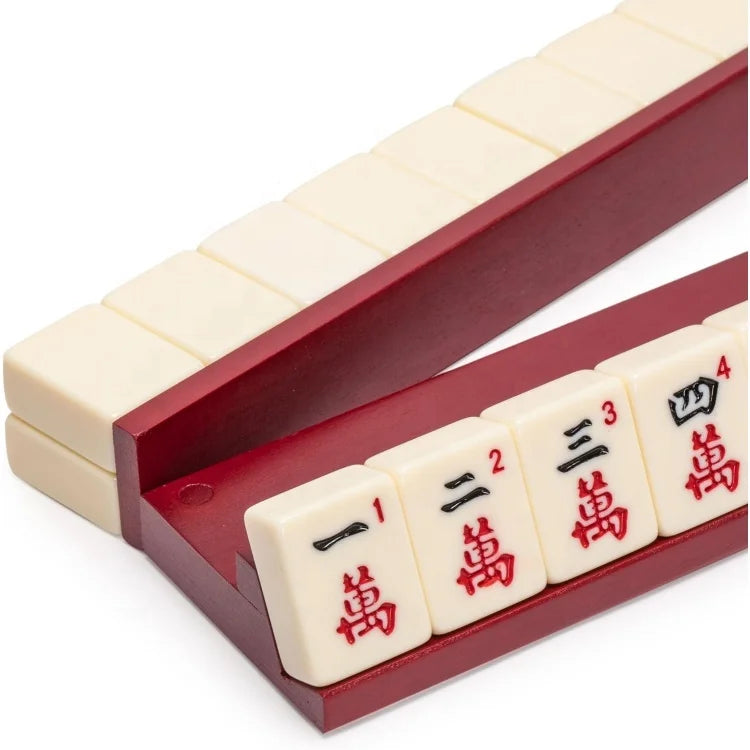
Before the first pass of the Charleston, the table needs to be set up: tiles shuffled, walls built, the wall broken with the dice, and the tiles dealt. It takes a few minutes the first time and gets quick with practice. This guide follows the standard rules of the National Mah Jongg League (NMJL), which publishes the yearly card and the official rulebook. New to the game? Start with our beginner's guide to playing American mahjong.
What you need on the table
A standard game has four players and uses a 152-tile American set, including eight flowers and eight jokers. Our guide to how many tiles are in an American mahjong set shows how to check yours. You also need:
- Four racks, one per player.
- Two dice, used to break the wall.
- A current NMJL card for each player, since the hands change every year.
- A smooth surface. A mat or table cover is optional but helps tiles slide.
Step 1: Choose East
East rolls the dice, starts the deal and makes the first discard. There is no fixed East chair. For the first hand, many groups have everyone roll the dice and give East to the highest total, while in home games the host often just starts as East. Either is fine if the table agrees.
Play moves counterclockwise, which means to the right. After each hand the dice pass to the right and that player becomes the new East, whether someone won or the hand ended in a wall game.
Step 2: Shuffle the tiles
Turn all the tiles face down in the middle of the table and mix them with flat hands. Some players call this "washing" the tiles. Shuffle gently: slamming or tossing tiles flips them face up, which means more shuffling, and wears them over time.
Step 3: Build the walls
Each player builds a face-down wall 19 tiles long and two tiles high along the front edge of their rack. That is 19 stacks of two, or 38 tiles each, and four walls use all 152 tiles. Then everyone pushes their wall forward so the four walls meet in a square in the center of the table.
Racks with pushers (arms that attach to the rack) make this easier, since you slide the rack and arm forward together instead of nudging 38 tiles by hand. You can browse our racks and pushers, and our rack size guide explains why length matters with a 19-tile wall.
Step 4: Roll the dice and break the wall
East rolls two dice and adds them together. Starting from the right end of East's own wall, East counts off that many stacks (not single tiles) and separates the wall there. On a roll of 8, for example, East counts eight stacks from the right and makes a small gap.
The counted stacks stay where they are, at the right end of East's rack. They are the very end of the wall and will be the last tiles drawn. The longer section to the left of the gap is where the deal begins, so East pushes it forward toward the center. The roll is part of the official rules because it stops anyone from knowing in advance which tiles will come out first.
Step 5: Deal the tiles
Under the NMJL procedure, each player takes their own tiles in turn, starting with East. Some groups have East hand the tiles out instead, and the order is the same either way:
- East takes the first two stacks to the left of the break, which is four tiles.
- Moving to the right, each player takes the next two stacks.
- Continue around the table until everyone has 12 tiles (three trips around).
- East takes two more tiles at once: the top tile of the first stack and the top tile of the third stack, known as the "first and third" tiles.
- The other three players each take one more tile, in turn.
East now has 14 tiles and everyone else has 13. East needs the extra tile because East makes the first discard after the Charleston. Keep your tiles face down until the deal is complete.
When a wall runs out
Turns move to the right, but tiles come off the wall clockwise. Once the first section of East's wall is used up, the player on East's left pushes their wall out, angled toward the center so everyone can reach it. Next comes the wall of the player across from East, then the player on East's right, and finally East's leftover stacks. In short: when the wall in front of you runs out, the player on your left pushes theirs out next.
Check your count before the Charleston
Before the first pass, everyone counts: 14 for East, 13 for everyone else. Under NMJL rules, a wrong count before the Charleston means all the tiles are thrown in and the walls are rebuilt. Once East has made the first discard, a player with the wrong count has a dead hand, so those few seconds are worth it. Then you are ready for the passes, covered in our Charleston guide.
Quick reference: setup in 10 steps
- Seat four players, each with a rack and a current card.
- Choose East by high dice roll or by agreement.
- Shuffle all 152 tiles face down.
- Build walls 19 stacks long and two high in front of each rack.
- Push the walls together into a square.
- East rolls two dice and counts that many stacks from the right end of East's wall.
- Break the wall there and push the left section forward.
- Starting with East and moving right, take four tiles at a time until everyone has 12.
- East takes the top tiles of the first and third stacks, then the others take one each.
- Count (East 14, others 13), then begin the Charleston.
Common setup mistakes
- Counting tiles instead of stacks, or counting from the left. Count stacks from the right end of East's wall.
- Skipping the dice. It saves a few seconds, but it is not the official procedure.
- Pushing out the wrong wall. The next wall is always clockwise (to the left) of the one that just ran out.
- Forgetting East's extra tile. If East has 13 after the deal, the "first and third" step was missed.
- Losing track of the dice. Set them down on East's right, beside the next East, so nobody has to ask who deals next.
Frequently asked questions
How long is each wall in American mahjong?
Each wall is 19 tiles long and two tiles high, or 38 tiles per player. Four walls use all 152 tiles.
Do you count tiles or stacks after rolling the dice?
Stacks. East counts the dice total in stacks of two from the right end of East's own wall, then breaks the wall there.
Who is East in the next hand?
The player on the current East's right, after every hand, including wall games.
What if East is dealt a complete hand?
It is rare, but if East's 14 tiles already match a hand on the card, East declares mahjong right away and there is no Charleston. It is paid like a self-picked win, so everyone pays East double.
Once the walls are built and the tiles dealt, it helps to know what happens at the end of the hand too. Read how scoring and paying work in American mahjong next.