
November 4, 2026
How to Play American Mahjong: Rules for Beginners
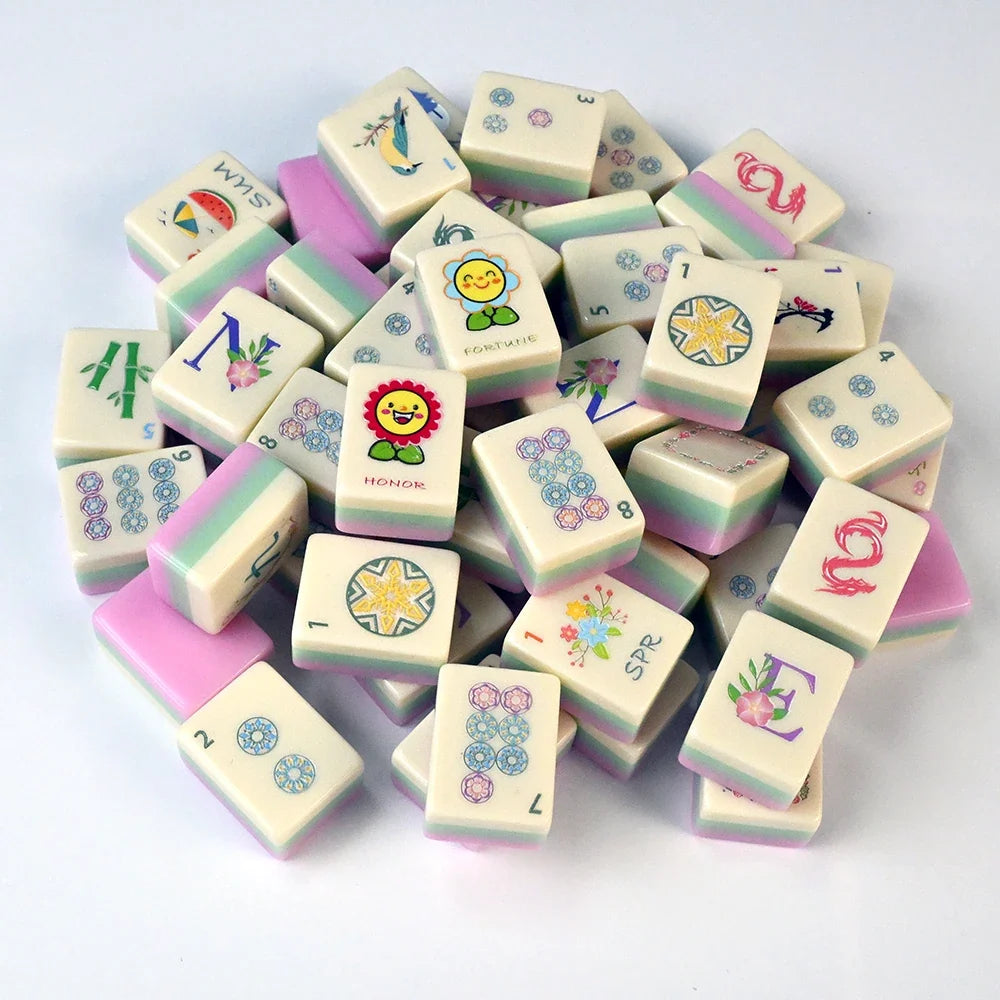
American mahjong is a game for four players, played with a 152-tile set and a card of winning hands that the National Mah Jongg League (NMJL) publishes every year. The goal: be the first to collect 14 tiles that exactly match one hand on the current card. This guide walks through a whole game in order, using the NMJL's standard rules. Many groups add house rules, so agree on yours before the first hand.
What you need
- An American mahjong set. It has 152 tiles: three suits (bams, craks and dots, numbered 1 to 9, four of each), 16 winds, 12 dragons, 8 flowers and 8 jokers. In American play, all flowers count as the same tile. Our guide to mahjong tile names and meanings explains every tile.
- Four racks, one per player, to hold your tiles. Many come with pushers that slide your wall toward the center.
- Two dice.
- A current NMJL card for each player. The hands change every year, and the card is published and sold by the League. Learn the layout in how to read the mahjong card.
Coins or chips for paying are optional. See the full checklist in what you need to play American mahjong.
Words you will hear at the table
| Term | Meaning |
|---|---|
| Pung | Three identical tiles |
| Kong | Four identical tiles |
| Quint | Five identical tiles. A set has only four of each suit, wind and dragon tile, so a quint of those tiles needs at least one joker. |
| Sextet | Six identical tiles |
| Exposure | A group you completed with a called discard and placed face up on top of your rack |
| Concealed hand | A hand marked C on the card. You build it entirely inside your rack, with no exposures. |
| Mahjong | A finished 14-tile hand that matches the card, and the word you say to claim the win |
Seats and the dealer
Each player sits behind a rack. To pick the first dealer, called East, everyone rolls the dice and the highest roll wins. Play moves to the right, which is counterclockwise around the table. After every hand, the role of East moves one seat to the right, no matter who won.
Building the wall and dealing
- Turn all the tiles face down and shuffle them.
- Each player builds a wall 19 tiles long and two tiles high in front of their rack. Push the four walls together into a square.
- East rolls two dice, counts that many stacks from the right end of their own wall, and breaks the wall at that point.
- East takes the first two stacks (four tiles). Moving to the right, each player takes four tiles in turn, and this repeats until everyone has 12.
- Everyone takes one more tile, and East takes one extra. East now has 14 tiles and the other players have 13.
Our guide to how to set up American mahjong covers each step in more detail.
The Charleston
Before play begins, players trade tiles they do not want in a series of passes called the Charleston. Every pass is three tiles, passed face down.
- First Charleston (required): pass right, then across, then left.
- Second Charleston (optional): pass left, then across, then right. Any player may stop it after the first Charleston ends and before the second one starts.
- Courtesy pass (optional): the two players sitting across from each other may trade zero to three tiles. Both pass the same number, so the player who wants fewer sets the count.
On the last pass of each Charleston (the first left and the last right), you may pass along some or all of the tiles you just received without looking at them. This is called a blind pass. Jokers can never be passed. Our Charleston guide goes deeper into the rules and strategy.
Taking a turn
East starts by discarding one tile without drawing first. After that, on your turn, draw the next tile from the wall, then discard one tile face up in the middle of the table and say its name out loud. You hold 13 tiles between turns and 14 during your own turn.
Calling a discard
If someone discards a tile you need, you can call it, but only before the next player picks a tile from the wall and racks it. You may call a discard for two reasons only:
- to complete a pung, kong, quint or sextet, which you then expose, or
- to complete your hand for mahjong.
You cannot call a discard for a single tile or a pair unless it is the tile that wins the game. After calling, place the group face up on top of your rack, then discard. Play continues from your seat, so any players between the discarder and you lose that turn. Once made, an exposure stays as it is for the rest of the hand.
If two players call the same tile, a call for mahjong beats a call for an exposure. If both calls are for the same purpose, the player next in turn after the discarder gets the tile.
If you are playing a concealed hand, you cannot call tiles for exposures. You may call a discard only for the final tile that gives you mahjong.
Jokers in brief
Jokers stand in for any tile, but only inside a group of three or more identical tiles: a pung, kong, quint or sextet. A joker can never be a single tile, part of a pair, or part of a group made of different tiles.
On your turn, once you have drawn or called a tile, you may trade a real tile for a joker in any exposure on the table, including your own, as long as your tile matches what the joker stands for. A discarded joker is dead, so nobody can call it. Our joker rules guide covers the details.
Going mahjong
When the tile you draw, or a discard you call, completes a hand on the card exactly, say "Mahjong" and lay all 14 tiles face up. Every detail must match the card: the tiles, the numbers, the suits, and whether the hand is exposed or concealed. The other players should check the winning hand against the card before mixing in their own tiles, because a mistaken call is much easier to sort out while every hand is intact.
When nobody wins: the wall game
If the last tile in the wall is drawn and discarded and nobody declares mahjong, the hand ends in a draw called a wall game. Nobody pays. The tiles are shuffled and the deal moves to the right.
Paying basics
Every hand on the card has a value printed next to it. Groups pay in coins, chips or points.
| How the hand ends | Who pays the winner |
|---|---|
| Mahjong on a discard | The discarder pays double the hand value. The other two players pay the hand value. |
| Mahjong on a tile drawn from the wall (self-picked) | All three players pay double. |
| Jokerless hand | All payments double again. This bonus does not apply to hands in the Singles and Pairs or Quints sections of the card. |
| Wall game | Nobody pays. |
For example, if a hand worth 25 is won on a discard, the discarder pays 50 and the other two players pay 25 each. The scoring and paying guide works through more examples.
Dead hands
A hand is dead when it can no longer become any hand on the card. Common causes include an exposure that fits no hand, exposing tiles for a hand that must be concealed, holding the wrong number of tiles, and calling mahjong by mistake. Usually another player points it out. A dead hand stops drawing and discarding for the rest of that hand, but the player still pays the winner. Everyone is dealt back in for the next hand.
Common beginner mistakes
- Passing a joker in the Charleston. Keep every joker you are dealt.
- Calling a discard for a pair. Singles and pairs have to come from tiles you draw or receive in the Charleston, unless the tile completes mahjong.
- Racking a called tile. A called tile goes face up on top of your rack with its group, not into your hand.
- Exposing too early. An exposure locks you in, so make sure it fits a hand you can still finish that is not concealed.
- Losing count. Too many or too few tiles makes a hand dead. Keep 13 between turns.
- Picking too fast. Give the table a moment to call the last discard before you draw and rack your tile.
- Using last year's card. Switch to the new card once everyone at the table has one.
Frequently asked questions
How many players do you need?
The standard game is for four. Groups do play with fewer or more players using adapted rules, and those vary from table to table.
Can I play without the NMJL card?
Not the standard game. The winning hands exist only on the card, and they change every year, so each player needs a current copy.
Can a joker be used in a pair?
No. Jokers work only in groups of three or more identical tiles.
Do we have to play the second Charleston?
No. The first Charleston is required, but the second is optional, and any one player can stop it before it begins.
The easiest way to learn is to play a few practice hands with all tiles face up and the card on the table, talking through each choice. Once the order of play feels natural, the guides linked above cover the finer points.