
November 4, 2026
How Scoring and Paying Work in American Mahjong (and What the Coins Are For)
Scoring in American mahjong is simpler than in many other styles of the game. Nobody adds up points for each set. Only the winner is paid, the value of the winning hand is printed on the card, and a few doubling rules decide what each player owes. This guide covers those rules as the National Mah Jongg League (NMJL) sets them out, plus how groups use coins or chips. Still learning how a hand is played? Start with our guide to playing American mahjong.
Where a hand's value comes from
Every hand on the NMJL card has a value printed next to it. The League publishes a new card every year, so the hands and their values change. Values usually start at 25, and harder hands are generally worth more, because difficulty is built into the value. Each hand is also marked exposed (X) or concealed (C). For the full layout, see how to read the mahjong card.
Groups treat the value as points or as cents. The other players score nothing for their own hands, however close they came.
The three payment rules
1. Winning on a discard
If you win by calling another player's discard, the player who threw that tile pays you double the hand's value. The other two players pay the single value.
2. Winning on a self-picked tile
If you draw your winning tile from the wall, all three players pay you double. Winning by exchanging a tile for an exposed joker on your turn also counts as self-picked, since nobody discarded that joker to you.
3. The jokerless bonus
If your winning hand has no jokers when you declare mahjong, the value doubles again, on top of the first two rules. On a jokerless win from a discard, the discarder pays four times the value and the other two pay double. On a jokerless self-pick, all three pay four times the value.
- Announce it. The League has said you must declare the hand jokerless to collect the bonus. Players pay what the winner asks for, so a forgotten bonus is a lost bonus.
- Singles and pairs hands do not earn it. Jokers can never be used in those hands, so the bonus does not apply.
- Quints hands do not earn it either. A quint (five of a kind) normally needs a joker.
- It counts at the moment you win. If someone redeemed a joker from one of your exposures earlier and your hand has none when you declare, it is jokerless.
Our joker rules guide covers where jokers can and cannot be used.
A worked example
This table uses a value of 25 purely as an illustration. It is not a hand from any card, so substitute the value printed next to the winning hand on your own card.
| How the hand was won | Discarder pays | Each other player pays | Winner collects |
|---|---|---|---|
| On a discard, with jokers | 50 | 25 | 100 |
| On a discard, jokerless | 100 | 50 | 200 |
| Self-picked, with jokers | No discarder | 50 (all three) | 150 |
| Self-picked, jokerless | No discarder | 100 (all three) | 300 |
| Wall game (no winner) | 0 | 0 | 0 |
A singles and pairs hand never gets the jokerless doubling, so only the "with jokers" rows apply. At an illustrative value of 50, a self-picked singles and pairs hand collects 100 from each player.
Wall games, dead hands and mistakes
Wall games
If the wall runs out and nobody has declared mahjong, the hand is a wall game. There is no winner and nobody pays. The dice pass to the right for the next hand.
Dead hands still pay
A player whose hand is called dead stops drawing, discarding and calling for the rest of that hand, while everyone else plays on. If someone then wins, the dead player pays like any other non-winner. In a wall game nobody pays, the dead player included.
Declaring mahjong in error
If you call mahjong but catch the mistake before exposing any tiles, you can take it back with no penalty. If you have already exposed part or all of your hand and the other hands are still intact, your hand is dead: the exposed tiles go back to your rack, play continues without you, and you still pay if someone wins.
Penalties grow when other players act on a false call. If players throw in their tiles or break up the wall before checking the hand, the rulebook sets specific payments, often double a hand's value, owed by whoever made the mistake. So check every declared hand before touching your own tiles.
A misnamed discard
If a player names a discard wrongly and someone declares mahjong on the name they heard, the hand ends and the player who misnamed the tile pays the whole table's share: four times the hand's value. Nobody else pays.
What the coins are for
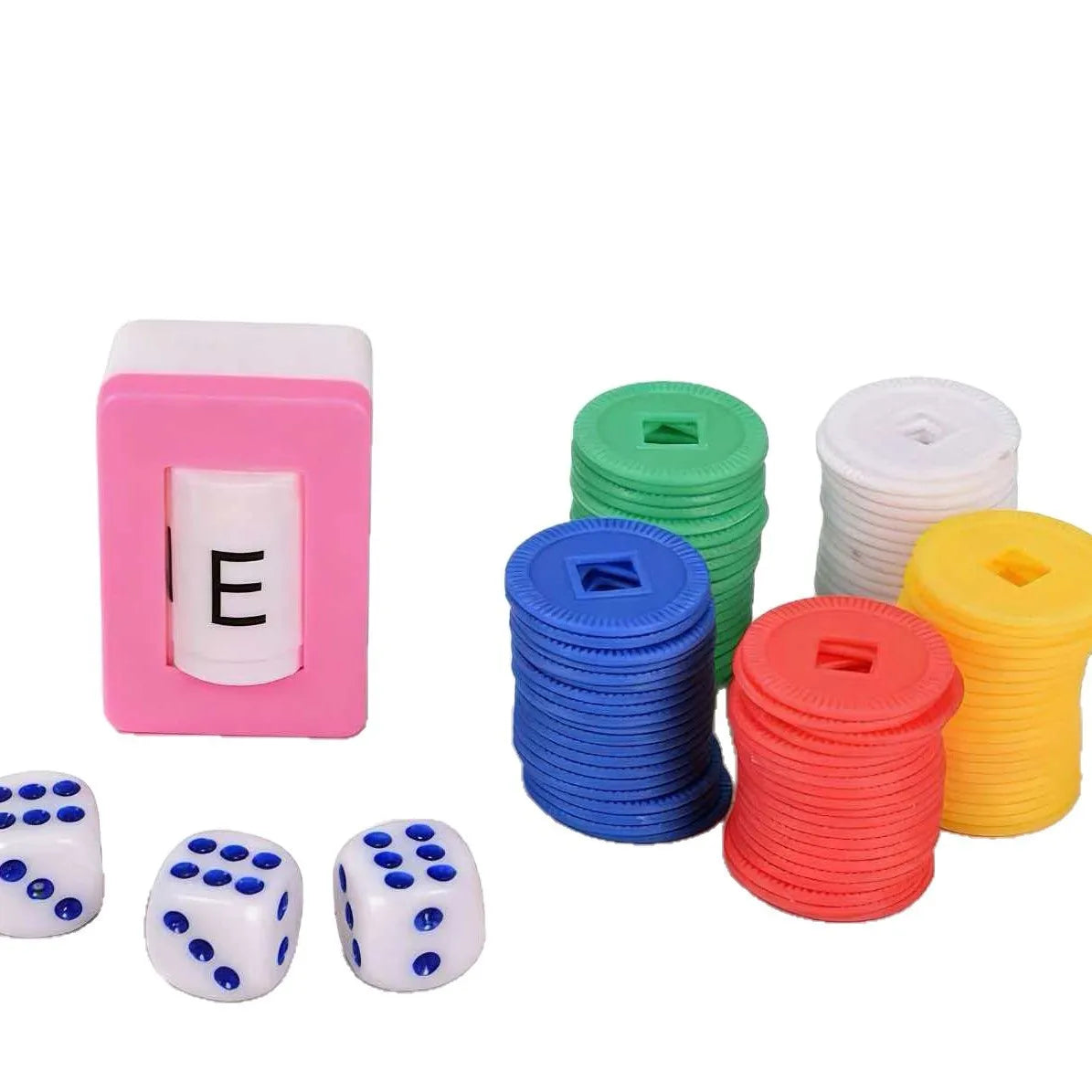
Many American mahjong sets include plastic coins or chips, often round with a square hole like old Chinese coins. They are a scorekeeping tool. Every player starts with the same number and mix, non-winners pass coins to the winner after each hand, and whoever has the most at the end is ahead. Many tables play purely for points. Groups that play for small change can settle up once at the end instead of passing cash after every hand.
No coin color has a required value, so agree on a system before the first hand. Tom Sloper, author of the rules book The Red Dragon and the West Wind, reports that the NMJL rulebook describes 1,000 points per player: two coins of the scarcest color worth 200 each, four worth 100, six worth 25 and ten worth 5. Whatever you choose, give everyone an identical stack. You can find coin sets and dice in our coins, dice and scoring collection.
The "pie," an optional limit
Some groups that play for coins use a "pie," a table rule that caps what anyone can lose in a session. Everyone starts with the same agreed amount, and a player who runs out keeps playing without paying more. The amount, and whether to involve money at all, is up to your group.
Good habits when paying
- The winner announces the amounts: the hand's value, how it was won, whether it is jokerless, and what each player owes.
- Pay while the winning hand is still on display, so everyone can check it.
- Agree on house rules first. Extras such as doubling when doubles are rolled, or "hot wall" penalties, are table rules, not NMJL rules.
Frequently asked questions
Who pays double in American mahjong?
On a discard win, the discarder pays double and the other two pay single. On a self-picked win, all three players pay double.
What are the coins in a mahjong set for?
Keeping score. Everyone starts with the same amount, non-winners pass coins to the winner, and the coins stand for points or small change, as your group prefers.
Does a singles and pairs hand get the jokerless bonus?
No. Jokers can never be used in those hands, so the bonus does not apply, though the discard and self-pick doubling still do.
Does anyone pay in a wall game?
No. There is no winner, so nobody pays and the deal moves to the next player.
Does a dead hand still have to pay?
Yes. If someone else wins that hand, the dead player pays like any other non-winner.
Once the three doubling rules click, settling a hand takes only seconds. For a refresher on starting the next hand, see how to set up American mahjong.